Insurance-Linked Securities (ILS): A Guide to the Market | Jonas Osman Abdelghafour
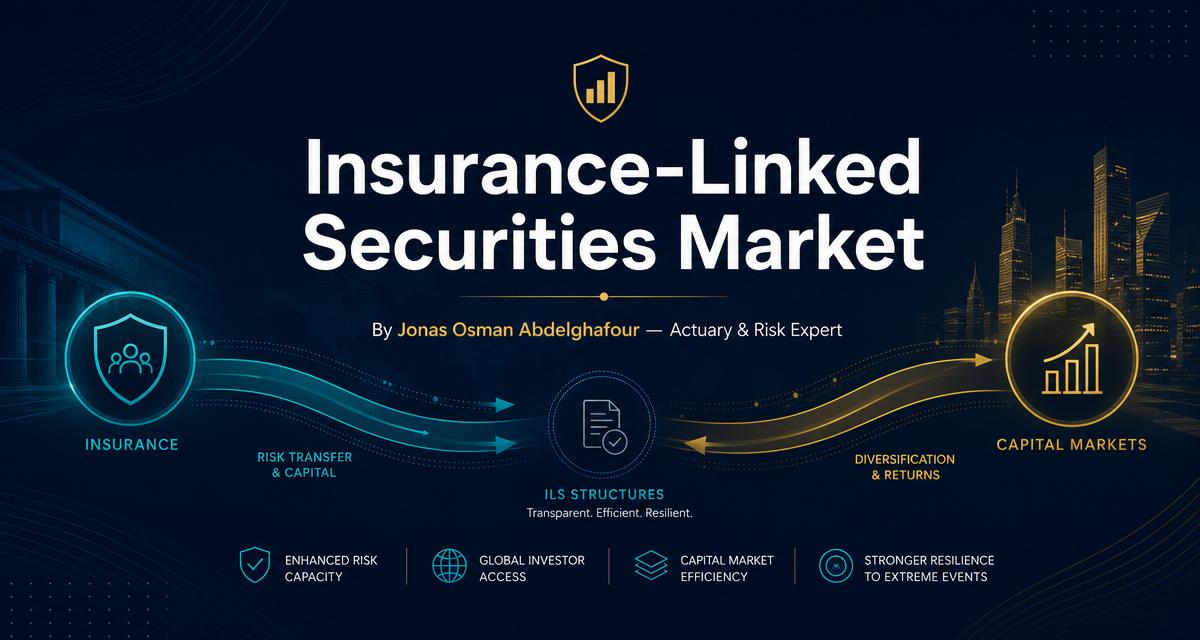
Jonas Osman Abdelghafour explains what insurance-linked securities are, how cat bonds, collateralized reinsurance, sidecars and ILWs differ, and how ILS capital reshaped reinsurance pricing.
# Insurance-Linked Securities (ILS): A Guide to the Market
*By Jonas Osman Abdelghafour — Actuary & Risk Expert*
Insurance-linked securities, or ILS, transfer insurance risk — mostly natural catastrophe risk — from insurers and reinsurers to capital market investors. Instead of a reinsurer promising to pay claims from its own balance sheet, an investor funds a structure that pays out if a defined insurance loss occurs, and earns a premium for taking that chance. A simple idea with far-reaching consequences: it turned hurricane and earthquake risk into an asset class, and permanently changed how reinsurance is priced.
Most commentary treats "ILS" and "catastrophe bonds" as synonyms. They are not. Cat bonds are the visible, tradable tip of a mostly private market. This guide maps the whole landscape — and its less advertised frictions.
## The insurance-linked securities landscape at a glance
The market is best understood as four overlapping segments, distinguished by liquidity, customization, and how closely investors' fortunes track a specific insurer's book.
**Catastrophe bonds** are the liquid end: securities, typically issued under Rule 144A to qualified institutional buyers, often rated, with a secondary market. A special purpose vehicle issues notes, holds the proceeds in safe collateral, and pays investors a coupon; if a qualifying catastrophe occurs, some or all of the principal goes to the sponsor instead. Standardized and tradable, cat bonds attract the broadest investor base and most of the headlines. Their mechanics — triggers, basis risk, pricing — get their own treatment in a separate article. The key point here: cat bonds are the exception in ILS. Everything else is private.
**Collateralized reinsurance** is the largest segment by capital deployed, and the least visible. An ILS fund writes an ordinary reinsurance contract — the same treaty a traditional reinsurer might write — but instead of a rated balance sheet, it posts collateral in trust, usually up to the contract limit. The cedant knows the money is there; the fund knows its maximum loss. These deals are bespoke, negotiated privately at renewal, and essentially illiquid: once written, held to maturity. This is where ILS competes head-to-head with traditional reinsurers, line by line.
**Sidecars** sit closer to a single counterparty. A sidecar is a special purpose vehicle taking a quota share of a sponsoring reinsurer's book — investors receive a proportional slice of premiums and losses on a defined portfolio. The appeal is alignment: the sponsor keeps skin in the game and does the underwriting. The corresponding risk is concentration in one underwriter's judgment. Sidecars tend to expand after major loss years, when sponsors want quick capacity and investors want hardened pricing, and to contract when margins thin.
**Industry loss warranties (ILWs)** are the bluntest instrument in the toolkit. An ILW pays out when an industry-wide loss estimate — say, insured losses from a US hurricane, as reported by an independent index provider — exceeds an agreed threshold, regardless of what the buyer actually lost. That makes ILWs fast to negotiate, with no need to examine the buyer's book, at the cost of an imperfect match between payout and actual loss. A rough-and-ready hedge, popular when protection is needed quickly.
## The retrocession market: reinsurance for reinsurers
Retrocession — reinsurance bought by reinsurers to protect their own accumulated portfolios — is disproportionately supplied by ILS capital, through collateralized retro contracts, sidecars, and ILWs. This makes structural sense: retro is peak-peril, high-severity, low-frequency risk, exactly the shape of exposure capital markets are willing to warehouse. It also means that when ILS capacity tightens, reinsurers feel it first through the cost of their own protection, and the effect ripples down to primary insurers and ultimately policyholders. The retro market is small in premium terms but acts as a pressure valve for the whole system.
## Where the capital comes from
ILS capital is overwhelmingly institutional. Pension funds are the anchor: catastrophe risk has little correlation with equities or credit — a hurricane does not care what the Federal Reserve does — making it a genuine diversifier for a long-horizon portfolio. Sovereign wealth funds, endowments, and family offices participate for similar reasons. Most of this money reaches the market through dedicated ILS fund managers, specialists who underwrite, structure, and manage portfolios of cat bonds, collateralized deals, and retro. A pension trustee does not price a Florida wind treaty; they allocate to a manager who does.
## Why alternative capital changed the pricing cycle
Reinsurance historically moved in pronounced cycles: a catastrophe destroyed capital, capacity shrank, prices spiked, new capital slowly formed companies to exploit the hard market, and prices drifted down again. Alternative capital shortened that loop dramatically. Capital markets money does not need to charter a company, hire underwriters, and earn a rating — it can flow into a fund or sidecar within months of a loss event. The observable result over two decades: post-event price spikes have been flatter and shorter-lived than in earlier eras. Good news for protection buyers; for traditional reinsurers, it removed much of the windfall that used to follow surviving a bad year. The cycle is not dead — recent years proved capital can also retreat — but its amplitude is dampened.
## Trapped capital: the collateral-release problem
Collateralization is the market's great strength and its structural weakness. When a contract expires without loss, collateral is released and redeployed. But after a major event, the cedant may hold collateral until losses are finally settled — and catastrophe claims can take years to develop. The investor's capital is "trapped": not necessarily lost, but unavailable, earning little, and unable to participate in the very post-event rate increases that would compensate for the loss. Funds manage this with buffer tables and commutation negotiations, but trapped capital remains a real drag on returns after active loss years.
## Loss creep and investor confidence
Related, and arguably more corrosive, is loss creep: the tendency of initial loss estimates for complex events to rise, sometimes substantially, over subsequent quarters. Wildfires, typhoons, and events with heavy litigation or demand surge have all produced estimates that kept growing long after the wind stopped. For investors, that means marks that keep deteriorating and collateral trapped longer than modeled. A run of creeping events in the late 2010s tested the market's patience and prompted a repricing — and, more constructively, tougher terms, sharper event definitions, and more conservative reserving. The market matured the hard way, which is usually how markets mature.
## The takeaway
Insurance-linked securities are not one product but a spectrum: liquid, standardized cat bonds at one end; private, bespoke collateralized reinsurance — the largest pool of capital — in the middle; sidecars and ILWs serving alignment and speed; and a retrocession market leaning on all of them. The capital is patient and institutional, and its arrival flattened the reinsurance pricing cycle in a way unlikely to reverse. The frictions are equally structural: collateral gets trapped after losses, and loss estimates creep. Anyone allocating to this market, or ceding risk into it, should understand both halves of that ledger.
*Jonas Osman Abdelghafour is an actuary and risk expert advising insurers, reinsurers, and institutional investors on catastrophe risk and ILS strategy. Weighing ILS capacity, a fund allocation, or your retro program? contact@jonasosman.org.*