Longevity Risk: Why Pension Plans Underestimate It — and What to Do
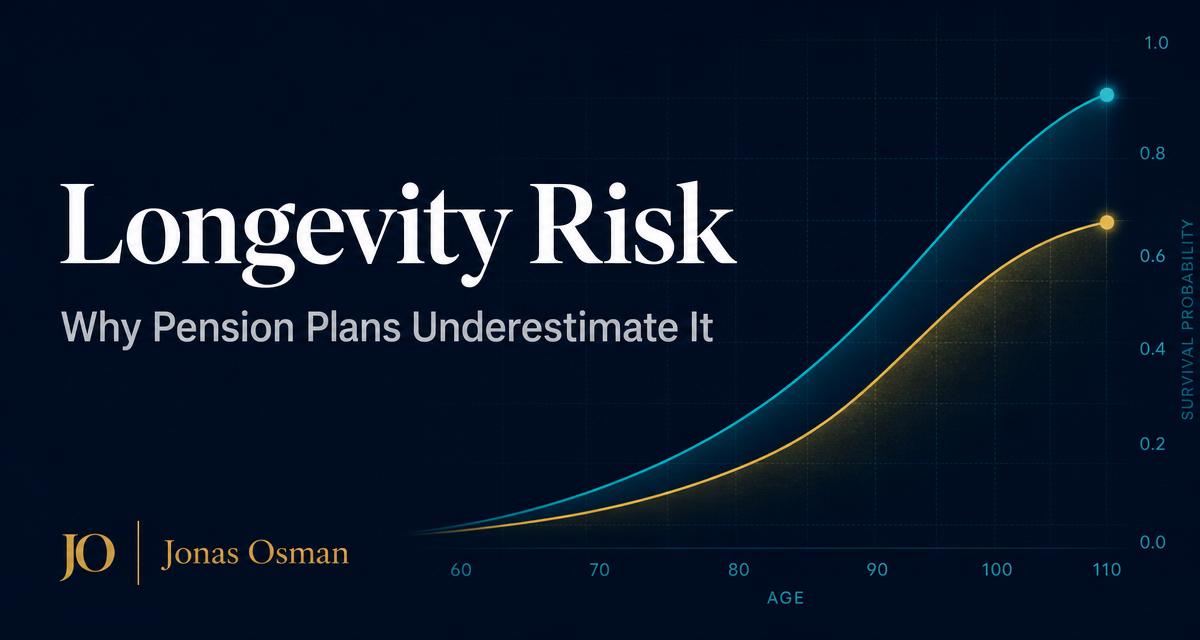
Longevity risk quietly erodes pension funding. An actuary explains how to measure it, why mortality tables mislead, and how buy-ins, buy-outs and swaps help.
# Longevity Risk: The Pension Threat That Compounds Quietly
By Jonas Osman Abdelghafour — Actuary & Risk Expert
Ask a pension trustee what keeps them up at night and you'll usually hear about interest rates or equity markets. Longevity risk — the risk that plan members live longer than the mortality assumptions predict — rarely makes the list. That's a mistake. Unlike a market crash, longevity risk doesn't announce itself. It accumulates in small, systematic valuation misses, year after year, until a plan that looked fully funded discovers it owes benefits for far more retiree-years than it ever reserved for.
A useful rule of thumb: for a typical defined benefit plan, each additional year of life expectancy at retirement adds roughly 3–5% to the value of pension liabilities, depending on the plan's discount rate, benefit indexation, and member demographics. That is not a tail scenario. That is the cost of being one assumption update behind reality.
It helps to separate two distinct components of longevity risk, because they call for different responses. The first is idiosyncratic — random variation around a correct average. Some members live to 78, others to 101, and in a large plan those differences mostly diversify away. A plan with 50,000 members carries very little of this. A plan with 300 members carries a lot, and a handful of long-lived pensioners can meaningfully move its funding position. The second is systematic: the risk that the average itself is wrong, that mortality improves faster than your assumptions across the whole population. This component does not diversify, no matter how large the plan. Medical advances, behavioural shifts, and public health changes move everyone's life expectancy together. It's the piece that has repeatedly caught the pensions industry off guard, and it's the one worth spending governance time on.
A mortality table is a snapshot: the probability of death at each age, estimated from recent experience. The trouble is that pension liabilities stretch decades into the future, so actuaries have to layer mortality improvement assumptions on top of the base table — projections of how death rates will fall over time. Two failure modes recur. First, base tables get stale. A plan using a table calibrated to general-population experience may badly misestimate its own membership: white-collar pensioners with large benefits systematically outlive blue-collar populations, and because longevity correlates with pension size, the liability-weighted life expectancy is longer than the headcount-weighted one. Experience studies and postcode- or salary-based adjustments exist precisely to correct this, yet smaller plans often skip them. Second, improvement projections are genuinely hard. Extrapolative models — the Lee-Carter family, the CMI projection model in the UK — project past improvement trends forward, but trends break. Improvements in cardiovascular mortality drove much of the late-twentieth-century gains and then slowed sharply in the 2010s across several developed countries. A pandemic can distort the recent experience data that models calibrate to, in both directions. The honest position is that no model reliably predicts the pace of mortality improvement thirty years out; the job is to understand the sensitivity and decide how much of that uncertainty the plan should retain.
Before any de-risking conversation, three pieces of analysis earn their cost. Run a sensitivity analysis — revalue liabilities with life expectancy shocked up by one and two years. If a two-year shock moves the funding ratio by more than the sponsor's risk appetite tolerates, longevity risk is material; write it down in the risk register with a number attached, not an adjective. Commission an experience study if the plan is large enough, comparing actual deaths against expected over the last five to ten years. A ratio of actual to expected deaths persistently below 100% is an early warning that the base table is too heavy. And check concentration: what fraction of liabilities sits with the largest 5% of pensions? Highly concentrated plans behave like small plans regardless of headcount, and idiosyncratic risk returns through the back door.
Once you know the exposure, the de-risking toolkit is a spectrum, not a single lever. A buy-in is an insurance policy held as a plan asset: the insurer pays the plan an income stream that exactly matches benefits for the covered members. The plan retains the liability and the member relationship, but its exposure to longevity, interest rate, and inflation risk on that block is hedged. Buy-ins are the natural first step because they don't require the plan to be fully funded on an insurer's pricing basis for the whole membership — a plan can insure its pensioner block and keep running. A buy-out goes further: the insurer takes on the liabilities directly, issues individual policies to members, and the plan's obligation is extinguished. This is the endgame for a sponsor that wants the plan off its balance sheet entirely, and it typically prices above the accounting value of liabilities — the gap between funding basis and insurer pricing basis is the sponsor's exit cost. A longevity swap isolates the longevity component alone: the plan pays a fixed leg based on expected mortality and receives a floating leg based on actual survival. Investment risk stays with the plan. Swaps suit large plans that are confident in their asset strategy but want the systematic longevity exposure capped. The trade-offs are basis risk (if the swap references an index rather than the plan's own members), collateral requirements, and counterparty exposure over a multi-decade horizon.
Pricing across all three instruments reflects the insurer's own view of mortality improvements plus a risk margin — which means de-risking is cheapest when your assumptions and the insurer's converge, and feels most expensive precisely when your table is stale and theirs isn't. Plans that keep their mortality assumptions current negotiate from a better-informed position.
Longevity risk is systematic, slow-moving, and routinely underweighted because it never produces a dramatic quarterly loss. The discipline that counters it is unglamorous: keep base tables current with experience studies, stress-test improvement assumptions rather than trusting a single projection, quantify the exposure in funding-ratio terms, and evaluate buy-ins, buy-outs, and longevity swaps as tools with distinct costs rather than as a single "de-risking" monolith. Plans that do this work retain the risks they choose to retain. Plans that don't, retain them by default — at whatever price the eventual correction imposes.
---
Jonas Osman Abdelghafour is an actuary and risk expert who advises pension plans, insurers, and corporate sponsors on longevity risk, reserving, and enterprise risk management. If your plan needs an independent view on its mortality assumptions or a de-risking strategy review, reach out at contact@jonasosman.org.